From October to early March, the sun in the UK is not strong enough for your skin to make the vitamin D your body needs. That is why the NHS says everyone should consider a daily vitamin D supplement during autumn and winter. The advice is simple; the shelf is not. Vitamin D comes in a dozen forms, strengths and combinations, and the labels use two different units.
This guide explains what to look for so you can compare products sensibly. It is general information, not personal medical advice.
What the NHS actually recommends
The official guidance for the UK is short and worth knowing before you shop:
- Adults and children aged 1 and over: 10 micrograms (mcg) a day during autumn and winter.
- Babies under 1: 8.5 to 10 mcg a day if they are breastfed or have less than 500ml of infant formula a day (formula is already fortified).
- Children aged 1 to 4: 10 mcg a day all year round.
- Some groups should consider 10 mcg a day all year: people who are rarely outdoors (for example if they are housebound or live in a care home), people who usually cover most of their skin outdoors, and people with dark skin, including those of African, African-Caribbean or South Asian background.
The NHS also sets an upper limit. Adults, including pregnant and breastfeeding women, and children aged 11 to 17 should not take more than 100 mcg (4,000 IU) a day. For children aged 1 to 10 the limit is 50 mcg (2,000 IU), and for babies under 12 months 25 mcg (1,000 IU). If you have a medical condition or take prescribed medicines, ask your GP or pharmacist before starting a supplement.
Micrograms and IU: reading the label
Vitamin D is labelled in micrograms (mcg or µg), in international units (IU), or both. The conversion is fixed: 1 microgram equals 40 IU.
| Micrograms | IU | Where you see it |
|---|---|---|
| 10 mcg | 400 IU | The NHS daily amount for adults and children over 1 |
| 25 mcg | 1,000 IU | A very common strength for tablets and sprays |
| 50 mcg | 2,000 IU | Upper limit for children aged 1 to 10 |
| 100 mcg | 4,000 IU | Upper limit for adults and over-11s |
Two things trip people up. First, the strength on the front of the pack is not always the strength per tablet: some products give the amount per “daily serving” of two capsules or several drops. Second, percentages of the NRV (nutrient reference value) look alarming on higher-strength products. A 25 mcg product shows 500% of the NRV, because the NRV for vitamin D is 5 mcg. That figure alone does not mean the product is unsafe, but it is a reminder to check the total you take from all sources.
D3 or D2?
Supplements contain one of two forms:
- Vitamin D3 (cholecalciferol) is the form your skin makes in sunlight. Most D3 in supplements is made from lanolin, a substance from sheep’s wool, so it is not vegan.
- Vitamin D2 (ergocalciferol) comes from plant and fungal sources, such as UV-exposed mushrooms.
A 2012 systematic review and meta-analysis (Tripkovic and colleagues) found that D3 raised blood levels of vitamin D more effectively than D2. For that reason many people choose D3 where they can.
If you are vegan, you no longer have to settle for D2. D3 made from lichen, an organism formed by a fungus and an alga, is now widely available and is labelled as vegan or “plant-origin” D3.
Tablets, drops, sprays or gummies
The form matters less than taking it consistently, so choose the one you will actually use every day.
- Tablets and softgels are the cheapest per dose and easy to store. Softgels usually contain the vitamin in oil.
- Drops suit babies, young children and anyone who struggles with tablets. Check how much one drop contains: some products deliver 100 IU per drop, so the daily amount is several drops.
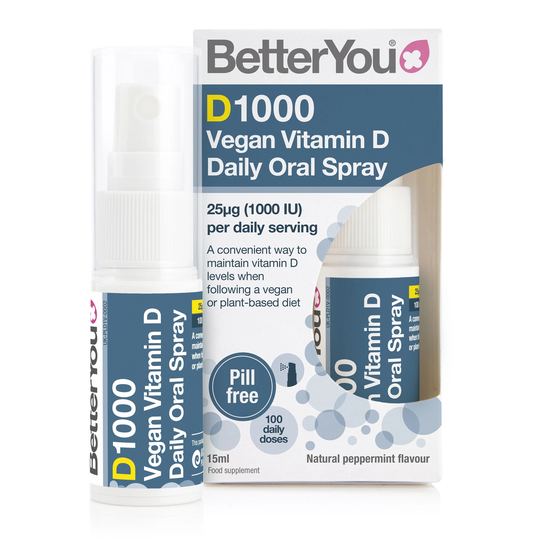
- Oral sprays are sprayed onto the inside of the cheek. They are handy if you dislike swallowing pills. A spray such as BetterYou D1000 Vegan delivers 25 mcg (1,000 IU) of plant-origin D3 per spray, which is more than the NHS daily amount, so check whether that strength is what you want.
- Gummies and chewables are popular with children, but they often contain sugar, and they look like sweets. Keep them out of reach of young children.
When you compare prices, work out the cost per daily dose rather than per pack. You can line up strengths, forms and pack sizes across retailers in our vitamin D supplements section.
Combination products and doubling up
Vitamin D is added to a lot of products, and that is where people accidentally take more than they intended. Before you buy a separate vitamin D, check what you already take:
- Multivitamins. Many adult and children’s multivitamins already contain vitamin D, often 10 mcg or more.
- Fish oil and cod liver oil. Some omega-3 products include vitamin D, and cod liver oil also contains vitamin A, which pregnant women are advised to avoid in large amounts.
- Calcium and bone health products. These are often combined with vitamin D.
- Vitamin D with K2. These combinations are common; the vitamin D content is what counts towards your total.
- Fortified foods. Some breakfast cereals and fat spreads are fortified. UK cows’ milk is generally not.
Add up the vitamin D from everything on the list. If the total is close to or above the upper limit, choose a lower-strength product or drop one of them.
Food and daylight still count
A supplement covers the gap, but food helps too. Good sources include oily fish such as salmon, sardines, herring, trout and mackerel, as well as egg yolks, red meat and fortified foods. Liver contains vitamin D but should be avoided in pregnancy.
From late March or early April to the end of September, most people can make enough vitamin D from sunlight on their skin. If you spend those months mostly indoors, talk to a pharmacist about whether to keep taking a supplement.
Quick questions
Is it better to take vitamin D with food? Vitamin D is fat-soluble, so many people take it with a meal that contains some fat. Follow the instructions on the pack.
Can I take a higher dose for a few weeks to “top up”? Do not go above the NHS upper limits unless a doctor has told you to. Some people are prescribed higher doses after a blood test, but that should be decided and monitored by a doctor.
Do I need a blood test first? Not for the standard NHS advice of 10 mcg a day in autumn and winter. If you have symptoms or a condition that affects absorption, your GP can decide whether a test is useful.
The simplest next step is to look at the supplements already in your cupboard, add up the vitamin D they contain, and only then decide whether you need a separate product and in which strength.